
Marketing is the activity, set of institutions, and processes for creating, communicating, delivering, and exchanging offerings that have value for customers, clients, partners, and society at large. Marketing, which was once centered on “sell them whatever we have – Push Strategy,” has found its new focal, i.e., “let’s give them exactly what they want – Pull Strategy.” The driving force behind this morphosis is more empowered customers, which further leads to companies’ increased desire to be ‘customer centric’ – to build relationships beyond transactions, fuelled by understanding ability, behavior, motivation, and triggers.
Before we further delve into the intricacies of understanding customers, it is important to begin by providing a decipherable framework for ‘marketing.’
Marketing decisions are usually demarcated around three verticals: (S) identifying an opportunity (gap) in the market and understanding the commerciality of this opportunity for different segments, (T) selecting the segment they want to serve, and (P) developing a competitive value proposition – (STP).
Marketers make these decisions either through sense-making, i.e., intuition-based or data-driven decision-making. The latter is being given the front seat owing to the rising competition, customer complexity, IT Boom (availability of data and increased computing powers), and cost associated with the hit-and-trial approach (monetary cost and customer churn ). With the increasing relevance of reliable data, considerable resources are being spent on Market research (which provides us with data to gauge into customers’ fears, wants, and needs). This can provide marketers with ‘actionable and competitive marketing insights.’ Marketing insights are defined as the ‘links’ between chunks of market information and render the company with a competitive edge. In other words, marketing insights are retrospectively evident things that marketers now uncover with the help of complex data mining and analytics processes. Therefore, to unearth insights from market research, companies resort to ‘Analytics’ (which will help marketers in converting customers’ fears, wants, and needs into features, benefits, values, and experiences derived from the product).
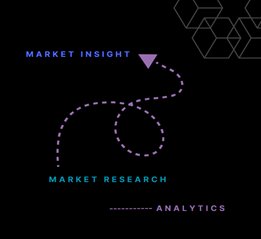
Fig 1: Analytics bridging the gap between data and decisions
Plugging analytics into the STP framework would seem like this: (S) the commerciality of an opportunity is assessed using a well-known model for market analysis, “TAS (Total Potential Customers × Revenue Per Customer), SAM, SOM” (Fig. 1). (T) The target segment should be accessible, measurable, profitable, substantial, and actionable. (P) Further, the brand’s positioning originates from what will (possibly) hook the customer the most, for which companies map themselves on a Positioning Map (a visual representation of how my brand should be seen by my ideal customers).
The use of analytics in marketing ranges from understanding market opportunities through descriptive and diagnostic analytics to using predictive analytics for selecting the target audience and finally deploying prescriptive analytics to develop the most attractive and lucrative value proposition.
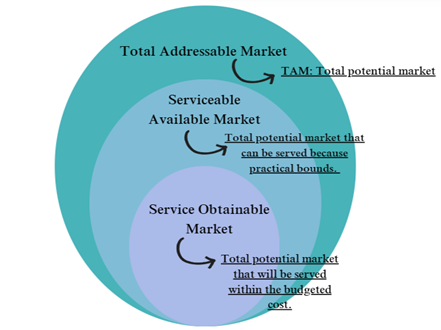
Fig 2: TAM, SAM, and SOM
As ‘data’ is the precursor of insights, companies strive to get this “data vantage” by having as much information about customers as possible, which helps them understand the pattern of consumer decision-making. Majorly, this customer information is bifurcated between transactional and demographic information. This customer information can be associated with any. To categorize different types of data available to a company based on their importance and complexity, analysts use- the ‘Marketing Research Analysis Matrix’ (3). Based on the data’s category, marketers can decide its criticality and how much resources and time will be spent on the analysis. Below given is an example of the same:
| Marketing Research Analysis Matrix | High Complexity | Low Complexity |
| High Importance | Social Media Sentiment Analysis / Predictive Modelling | CLTV – Customer Lifetime Value Analysis |
| Low Importance | Customer Purchase History at the Granular Level | Social Media followers count |
Table 1: Marketing Research Analysis Matrix (2)
“Is ‘data’ set to replace ‘creativity’ as the fuel for marketing?”
Still, as it goes without saying, the mere availability of insight does not make the difference, as an appropriately devised action must follow it. The timely execution of a plan of action in accordance with the results (of analytics) gives conglomerates an advantage over other players in the market.
Thus, companies use a straightforward tool to come up with an effective and efficient action based on the insights drawn from data: the “job-to-be-done Matrix (JTBD Matrix).” This Matrix, at first, mentions what the customer wants (insights). Followed by what attributes in the product are to be added to deliver the customer’s requirements and what product ingredient will render us the sought-after attribute at the minimum cost. The chosen plan of action must have maximum benefits against cost, entering the picture (almost every time we deal with the corporate-darling, ‘profit’) – Cost and Benefit Analysis. Given below is a hypothetical example of the JTBD matrix along a chocolate:
| Want | Attribute | Action on ingredients |
| A dessert that treats customers in the right proportion (Trade-off between sweetness and calorie intake). | Smaller Pack Less sweet Healthy Dessert | Newer/ Smaller Packaging Natural sweeteners Fibre-rich ingredients Reduce the sugar content Healthy Fats |
Table 2: JTBD: Job-To-Be-Done Matrix
Conjoint Analysis is another type of analysis used by marketers to decide the intricacies of their plan of action (value proposition to customers). It helps them rank product features and attributes based on customer preferences, allowing them to incorporate the most valued elements into the final offering (4). Further, one widely used metric to evaluate the performance of a market offering (action executed) is the “Net Promoter Score,” which is how likely customers are to recommend the brand to their friends or family members. NPS is a loyalty score with multiple customer categories: Promoters, Passives, and Detractors.
However, it must be noted that the availability of mammoth data is a two-edged sword that can often lead to cumbersome data filtering processes, faulty conclusions, data deluge (Information overload), development of algorithm bias, and, most importantly, ethical and privacy concerns. Internationally, so much data is being created every second that statisticians and data scientists anticipate Global Data Creation by 2035 to be 2142 Zettabytes (5). Furthermore, there are mounting numbers of cases where companies have fallen prey to civil complaints lodged against them for not abiding by the ethical boundaries of customers while collecting or exploiting the information. Thus, the administrative systems of different nations are exploring the need to introduce legal procedures to keep an eye on exacerbating cybercrime scenarios.
Technological innovations positively add to the customer experience with the brands. Notwithstanding, organizations should recognize that customers also fear companies overstepping their boundaries. One such instance is Target’s recommendation of baby products to a teen girl who had not yet disclosed her pregnancy to her parents or friends. This is a negatively perceived case of ‘Behavioural Targeting’- targeting advertisements and online promotional messages to the customer after analyzing his/her online behavior using a digital footprint.
Lastly, Research findings are crucial to determining a marketing insight, and companies widely use it to establish their claim regarding the effectiveness and popularity of their products. However, research findings can be modified or altered to cater to the intended purpose, often “misleading” the customers or other stakeholders. Therefore, even minimal alterations to the data or the analysis can be ethically wrong or can even land the company in legal proceedings. Hence, abiding by the research ethics and code of conduct is sacrosanct. Thus, companies must acknowledge that although wealth maximization is crucial, customers can not be kept in the back seat or bluffed.
The paradoxical dichotomy of ethics and effectiveness in marketing analytics is unfathomable. Marketers are left with no choice but to be conscientious as well as progressive because now customers would want their music “wrapped” [4] and movies “recommended”[5].
References:
- https://www.statista.com/statistics/242477/global-revenue-of-market-research-companies/
- https://fibery.io/blog/product-management/value-complexity-matrix/#:~:text=The%20value%20vs%20complexity%20matrix%20is%20a%20decision%2Dmaking%20tool,adding%20value%20and%20managing%20complexity
Note: All the graphics in this document are independently created.
[1] Marketing definition by AMA (American Marketing Association)
[2] STP – Segmenting, Targeting and Positioning
[3] The Positioning Map captures how a company would like its customers to see its brand. However, it is the Perception Map that actually represents how customers perceive the brand in reality.
[4] “Wrapped” – Here, Spotify’s Wrapped annual marketing campaign, which curates the summary of customers’ listening habits.
[5] “Recommended” – Here, Netflix’s recommendation model which suggests content to customers based on their previous watching habits.
Leave a Reply