
Every brand dreams of growth—but very few know how to grow strategically.
That’s where one of marketing’s most classic frameworks comes in: the Ansoff Matrix.
Created by Igor Ansoff, this model helps brands choose the right growth path by analyzing markets and products. It’s simple, practical, and used by marketers, founders, and MBAs across the world.
Here’s a deep dive into how the Ansoff Matrix works and how brands apply it today.
What Is the Ansoff Matrix?
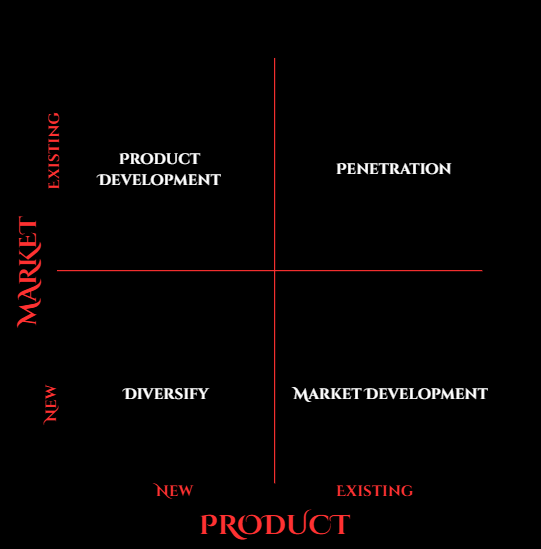
The Ansoff Matrix is a 2×2 strategy tool that helps businesses decide their growth direction using two variables:
- Products – existing or new
- Markets – existing or new
This gives four growth strategies:
- Market Penetration
- Market Development
- Product Development
- Diversification
Let’s decode each one with real brand examples.
Market Penetration (Existing Product × Existing Market)
Goal: Sell more to the same market.
Risk Level: Low.
Companies use this strategy when they want to increase market share without changing their core product.
How brands do it:
- Price cuts
- Promotions
- Loyalty programs
- More distribution
- Heavier advertising
Examples:
- Coca-Cola running festive campaigns to increase consumption frequency.
- Netflix pushing engagement through personalized recommendations.
- Zomato offering discounts to drive repeated orders.
Best for: early-stage brands or saturated markets.
Market Development (Existing Product × New Market)
Goal: Take the same product into a new market.
Risk Level: Medium.
Brands expand geographically or target new customer segments.
How brands do it:
- Launching products in new countries
- Targeting new demographic groups
- Entering new retail formats
Examples:
- Starbucks expanding from the U.S. into Asia and Europe.
- Nykaa launching Nykaa Man to target male customers.
- Dabur Hajmola creating Hajmola Chatcola for kids.
Best for: brands seeking volume expansion.
Product Development (New Product × Existing Market)
Goal: Introduce new products to existing customers.
Risk Level: Medium to high.
This strategy works when customer needs evolve or competition intensifies.
How brands do it:
- Upgrading products
- Launching new variants
- Adding complementary products
- Using innovation to retain customers
Examples:
- Apple launching new iPhones every year.
- Amul entering chocolates, beverages, and more for its existing consumer base.
- Maggi launching Atta Noodles and Oats Noodles.
Best for: innovation-driven brands.
Diversification (New Product × New Market)
Goal: Enter completely new markets with new products.
Risk Level: Highest.
Used when brands want to de-risk or unlock long-term opportunities.
Types of Diversification:
- Related: leveraging existing capabilities
- Unrelated: entering a totally new space
Examples:
- Tata acquiring Air India (unrelated diversification).
- Amazon entering cloud computing with AWS (related capabilities).
- Reliance expanding from oil to telecom with Jio.
Best for: large companies with strong resources.
Why the Ansoff Matrix Still Matters Today
Even with modern tools like growth loops and funnel models, the Ansoff Matrix remains relevant because:
- It simplifies growth decisions
- Helps marketers evaluate risk vs reward
- Guides brands on resource allocation
- Works for both startups and global brands
It’s a timeless framework because growth will always come down to two questions:
👉 Should we sell more of what we already have?
or
👉 Should we create something new?
How to Use the Ansoff Matrix for Your Brand
Ask yourself:
Market Penetration
- Can I increase repeat purchases?
- Can I improve promotions or distribution?
Market Development
- Who isn’t using my product yet?
- Which cities/countries can I enter?
Product Development
- What do my existing customers want next?
- What unmet needs can I solve?
Diversification
- Which new markets will define the future?
- Do I have capabilities to play there?
Conclusion
The Ansoff Matrix is not just a framework—it’s a mindset. It helps brands grow intentionally instead of randomly. Whether you’re scaling a startup, managing a brand, or preparing for your next marketing interview, mastering Ansoff gives you the clarity to make bold yet informed decisions.
Growth isn’t accidental.
It’s strategic.
And Ansoff helps you choose the right strategy.
Leave a Reply